
What DOC Mugshots Mean Statewide
The Massachusetts Department of Correction oversees the state prison system. Most people call it DOC. It has no hand in the fourteen county sheriff systems or local police lockups. A local police log can name a person. A county search can show custody. Neither guarantees a DOC result. Each record stays with its own agency. Start by matching the event to the custodian.
The word mugshot covers more than one kind of image. One is a booking photo taken right after an arrest. The other is an ID photo made later for prison administration. They are different records. DOC 402 covers identification photos for people in DOC custody. The public service linked from the DOC search instructions has a narrower job. It reports custody status only. It is not a statewide arrest list or a photo archive.
Timing matters here. An arrest alone does not place anyone in a state prison. That step comes later. The arrest record may sit with police, a regional lockup, or a county sheriff, depending on where the person was processed. DOC handles only the state-prison layer.
How the DOC Offender Search Works
The Mass.gov instructions for finding someone in a Massachusetts prison point to VINELink. Massachusetts DOC takes part in Massachusetts VINE. DOC does not run the service itself. It reports custody status. Treat any result as word from one custody system, not a sweep of every arrest in the state.
- Open DOC’s current Mass.gov instructions. Follow the VINELink link, or call Massachusetts VINE at 866-277-7477.
- Choose Massachusetts DOC in the online service. This points the query to state-prison custody.
- Enter the person’s full first and last name or commitment number, the identifier used for a DOC commitment. The instructions do not promise results from a partial name.
- Read the status with its agency and date context. A name match alone does not prove that two records refer to the same person.
- If the result is not enough, check with the agency that holds the arrest, county booking, court case, or other record.
VINE is a separate service, and that shapes what the search covers. A result can confirm status in DOC custody. It is not a full case file. It also cannot stand in for a court docket, so do not guess when a result is missing or unclear.
Note: Massachusetts VINE includes a phone option, while the online locator remains a separate service from DOC itself.
The official Mass.gov prison-search instructions lay out the public route into the custody lookup, and no offender-photo gallery appears there. The page covers where to search.
The instructions back a custody-status search only. They promise neither a booking image nor a complete history of everyone DOC has ever held.
What the DOC Locator Shows
The public Mass.gov instructions explain how to run the search. They promise no fixed result fields. They say nothing about photos. Nor do they confirm the offender-profile fields that appear in some other correctional systems. The table sorts this out. It tracks what the current public locator documents and what it leaves open.
| Information | What the public DOC search supports |
|---|---|
| Search terms | The instructions say a search generally uses the person’s full first and last name or commitment number. |
| Purpose | The linked VINELink service is identified as a custody-status locator for Massachusetts DOC. |
| Result context | Read the displayed custody status with the agency and date context shown for the result. |
| Public photograph | The current public locator instructions do not present an offender photo or a browsable DOC image roster. |
| Charges and disposition | The locator is not described as a complete charge list or court disposition record. |
These limits apply to the public instructions. They say nothing about internal DOC records. The agency may hold identification photographs that never surface in a public search. A custody result also cannot explain why someone entered custody or how the case ended. The VINELink public landing page shows the separate service used for Massachusetts custody status. It displays the interface, not any person's result.
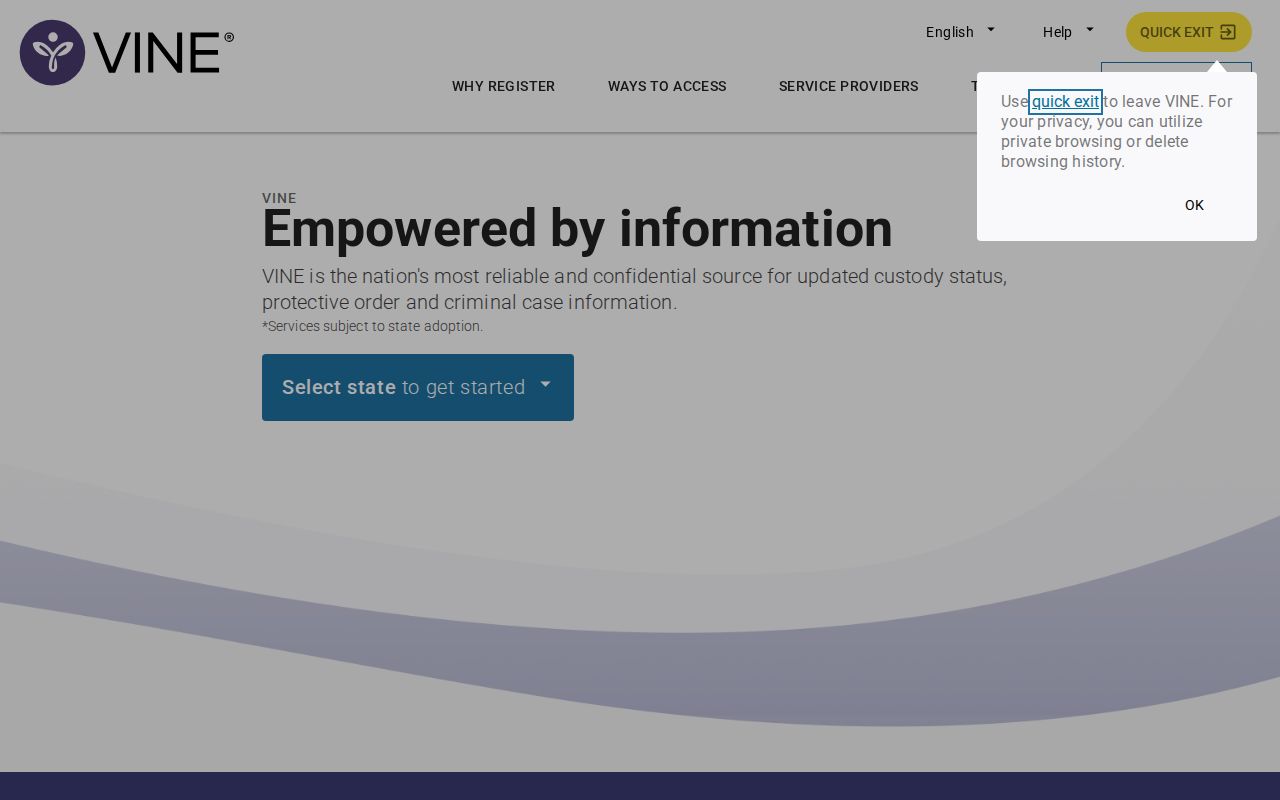
A sample interface proves nothing about a person. For a case outcome, use the Massachusetts Trial Court's MassCourts portal and its docket search instructions. A disposition is the court's case outcome. A docket can show events and dispositions where public access allows. It supplies no booking photo. Remote documents vary by court and case type, and sealed or restricted material may not appear.
How DOC Identification Photos Are Used
The DOC keeps its photo rules in writing. Its public-policy collection includes DOC 402: Inmate Identification, which spells out frontal and profile views and sets standards for ID images. So the department clearly takes these pictures of people in its care. What the policy never promises is public display; nothing in it puts face images on offender profiles or in the custody search.
Internally, the images do real work. Staff use them to confirm who is in custody and to support classification and movement decisions. That is recordkeeping, not a public gallery. DOC publishes no page where the public can browse face photos of state prisoners. VINE points only to custody status.
A specific photograph can still be requested. That does not make it automatically releasable. The custodian must weigh the public-records law alongside CORI, privacy, security, investigative, or other exemptions. Every case turns on the record and its facts. A DOC image is not public merely because an agency created it.
Note: DOC 402 is an identification policy, not a public posting schedule for offender photographs.
Why DOC Mugshots Aren't a Public Roster
Massachusetts offers a custody lookup, and it stops there. It is not a public mugshot roster. DOC's photo policy and the VINE instructions serve different jobs, with one explaining how the department records ID images and the other pointing people to custody status. So a status result never promises a photo.
The DOC policy covers frontal and profile images. VINELink's instructions offer no DOC photo gallery and no public photo field. A prison may take ID pictures and never post them. So the phrase "DOC mugshots" promises no browsable list.
The law does not change that. Massachusetts General Laws chapter 6, section 172 covers certain criminal-history and custody information. It creates no DOC mugshot feed. Custody data and ID photos stay separate, so describe the public search as it works rather than as a copy of DOC's internal files.
Absence from a public photo page proves nothing. It does not mean DOC never took an identification image. It only means the current search shows no browsable photo. A records request is the proper route.
What Is Known About Photo Updates
How often does DOC update its identification photos? The public locator instructions never say. No rule covers when an old image is replaced. None says whether a photo lingers after release. The policy material states no public update interval either. Treat all of this as unknown. Never fill the gaps with another state's prison system or an old third-party image.
Silence about updates cuts both ways. DOC may well change an internal record. The public sources give no interval to lean on. The search is no permanent archive of everyone DOC once held, and an old photo or a stale secondary page is no proof someone sits in prison today.
Old records deserve care. Check the date and the original source first. Then verify current custody through the official locator. A court docket can confirm a case outcome. It still cannot replace a live custody result. An empty VINE result proves nothing about the past. The instructions promise no historical all-person search and no lasting visibility for former offenders.
DOC Photos vs County Booking Photos
For a county comparison, see the Worcester County Sheriff's official inmate search. Its text-only results come from a different custodian and serve a different purpose than the DOC state-prison locator.
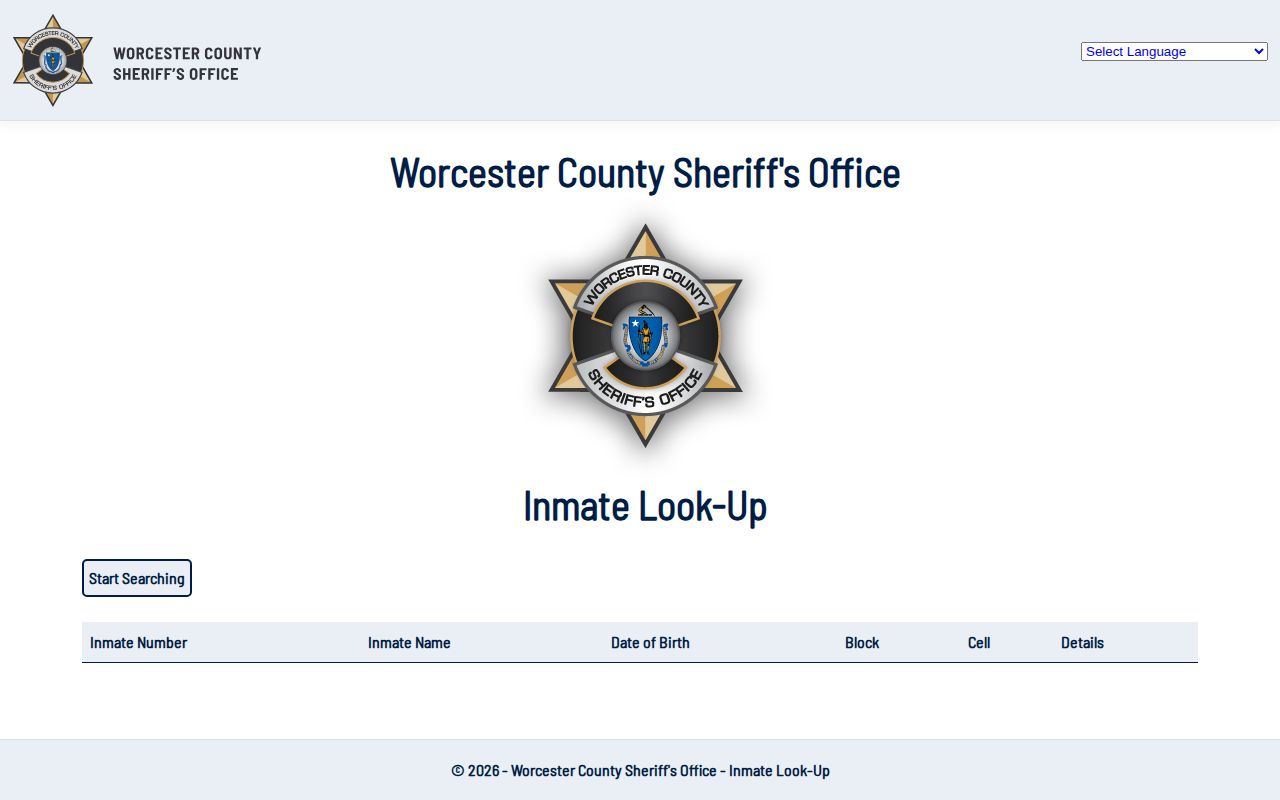
A DOC identification photo and a county booking photo come from different points in the process, with different custodians. The DOC keeps records for the state-prison system. County houses of correction answer to the sheriff. A city arrest can leave records in several hands instead. The police department, a regional lockup, or a sheriff's facility may hold them. No single daily sheriff photo feed exists statewide. So a county search usually starts with that county's own roster, published log, or records request process. That kind of local search works alongside a DOC custody check rather than replacing it.
| Record path | Custodian and purpose | Public photo expectation |
|---|---|---|
| DOC identification image | Massachusetts DOC; institutional identification records for the state-prison system. | DOC 402 describes images, but the current public custody locator does not display a photo roster. |
| County booking image | The sheriff or correctional department that holds the county booking record. | County posting practices vary; a public roster or photo feed is not uniform statewide. |
| Municipal arrest record | The arresting police department or the lockup that processed the person. | Online police logs are often text records. Request the image from the agency that may hold it. |
County booking questions start at the source. Ask the arresting department or the sheriff that handled custody, not DOC. The Massachusetts County Directory routes you to those county-level sources. The statewide Massachusetts arrest and mugshot search overview shows how municipal logs, county systems, courts, and other official sources fit together.
The court portal is a separate layer. A docket can confirm the case outcome. It is not the keeper of the booking image. Keep the arresting agency, the custody agency, and the court record distinct when you track one event across systems.
What a Missing DOC Result Means
A blank search result tells you very little. It is only a missing answer. No match does not mean the person was never arrested. It does not rule out a county hold or past DOC custody either. The public instructions never present VINELink as a full historical archive. Former offenders may drop out of search results. Before giving up, check your own inputs. Pick the right agency and enter the name or commitment number exactly as required.
Then match the event to the correct custodian. A local arrest sits with the police department that made it. County custody belongs to that sheriff's system. Federal incarceration lives in the federal locator. Immigration detention runs through a separate system entirely. These sources do not all carry photographs. No single one counts as a complete Massachusetts arrest database. A hit only shows what that custodian reports within its own scope.
When the question is how a case ended, pull the court record separately and read the docket entries in context. For a DOC photo or other DOC record, the remaining route is a direct request to the department, subject to the exemptions that apply.
How to Request Massachusetts DOC Records
The state's correction agency makes the first move easy. Its public-records request instructions name the Records Access Officer and walk through electronic, online, email, and mail submission. Be specific. Tie the request to one person or event, and list the name, commitment number, facility, date range, and record type. For a photo, state whether you want an identification photograph or a booking image. Avoid asking broadly for "all mugshots."
DOC Records Access OfficerKate Silvia
Massachusetts Department of Correction
50 Maple Street, Milford, MA 01757
Telephone: 508-422-3436
Email: doc.rao@state.ma.us
The DOC request-guidance page is the department's starting point for records-access instructions.
Skip screenshots. An image of the instructions proves nothing about a particular photo. A narrow request serves you better. Ask for one record, not a new statewide roster DOC would have to build. The agency accepts requests electronically, online, by email, or by mail. Name the record, the time span, and the format you want. You may ask for any segregable nonexempt part if something gets withheld. Save the response and any withholding explanation.
Fees are limited. DOC generally provides the first four hours of work free. After that, state agencies may charge up to $25 an hour for search and segregation work where the law allows. Timing is looser. The instructions promise no fixed release date. Under G.L. c. 66, § 10, a records officer generally must allow inspection or copying within ten business days, though state-agency extension rules can stretch that. A deadline does not force release.
Each record gets decided on its own. The definition of a public record appears in G.L. c. 4, § 7. Exemptions are legal grounds to withhold. CORI is Criminal Offender Record Information. It is defined in G.L. c. 6, § 167 and governed by 803 CMR 2.00. A photo alone is not automatically CORI. A booking sheet or case data can raise a separate CORI question. In its 2020 Boston Globe Media Partners decision, the Massachusetts Supreme Judicial Court held that booking photos are not categorically excluded from public-records review as CORI. That case involved a public-interest request about public officials. It did not order every photo released. An agency response will explain appeal options. Appeals still do not promise release. DOC is the wrong office for county or municipal booking images. If it does not hold the record, ask the sheriff, the police department, or whichever agency processed the person. Expect a full record, a partial one, a fee estimate, or a denial under an exemption.
Note: A request for one identified record is clearer than asking DOC to compile images or create a roster it does not maintain.