
Massachusetts Wanted Fugitives and Limits
No master wanted list exists for Massachusetts. Several official systems operate side by side. Each agency picks notices that fit its own mission. A person can appear on one list and stay off another, and someone with an active court warrant may not show up publicly at all. Use the exact status words the agency uses, like "fugitive" or "escapee." Three statewide sources matter most. The Massachusetts State Police runs one. The Department of Correction runs another. The U.S. Marshals Service District of Massachusetts runs a third. Their pages can display official photos and descriptions, but leave those images on the issuing agency's page, since a notice is a lead for law enforcement rather than an invitation to search for the person yourself.
Massachusetts Wanted List Comparison
These lists differ in scope, terms, and tip routes. Read the label beside each notice, then confirm the agency still lists the person as wanted.
| Official list | What it covers | Photo or details | Official source |
|---|---|---|---|
| State Police Most Wanted | Selected serious or often violent fugitives sought by Massachusetts State Police. | Use the current poster and status shown by State Police; a notice may remain online after a status changes. | Massachusetts State Police Most Wanted |
| DOC Most Wanted | People the Department of Correction identifies as DOC fugitives or escape-related. The page includes older cases as well as newer material. | Keep the agency's stated label. Do not recast an “absconder” or “escapee” notice as a new conviction. | Massachusetts DOC Most Wanted |
| U.S. Marshals profiled fugitives | Selected federal fugitive profiles connected to the District of Massachusetts. | Profiles may include a photograph and descriptors. This is not a routine federal-prison photo roster. | U.S. Marshals District of Massachusetts profiles |
Each agency updates on its own. No common count exists. The State Police page is a selected notice, not a complete statewide warrant search. An old page can lag a changed status, so check the current date and status before sharing a notice.
Note: Separate agency lists serve different purposes, so a result on one page does not confirm the status shown by another.
Massachusetts State Police Notices
The State Police page spotlights a selected set of serious fugitives, many tied to violence. Selection is the whole point. The page asks for help on listed cases. It does not enumerate every warrant in the state. Someone missing from it may still have a court matter, and a name on it still needs a current status check. Tips go to the Violent Fugitive Apprehension Section at 800-527-8873 or 508-820-2121, or to local authorities. The lists state no shared anonymity promise or reward. Follow the instructions on the notice you use, and never send a tip to an unofficial repost. The official State Police Most Wanted page carries the current notices and tip directions.
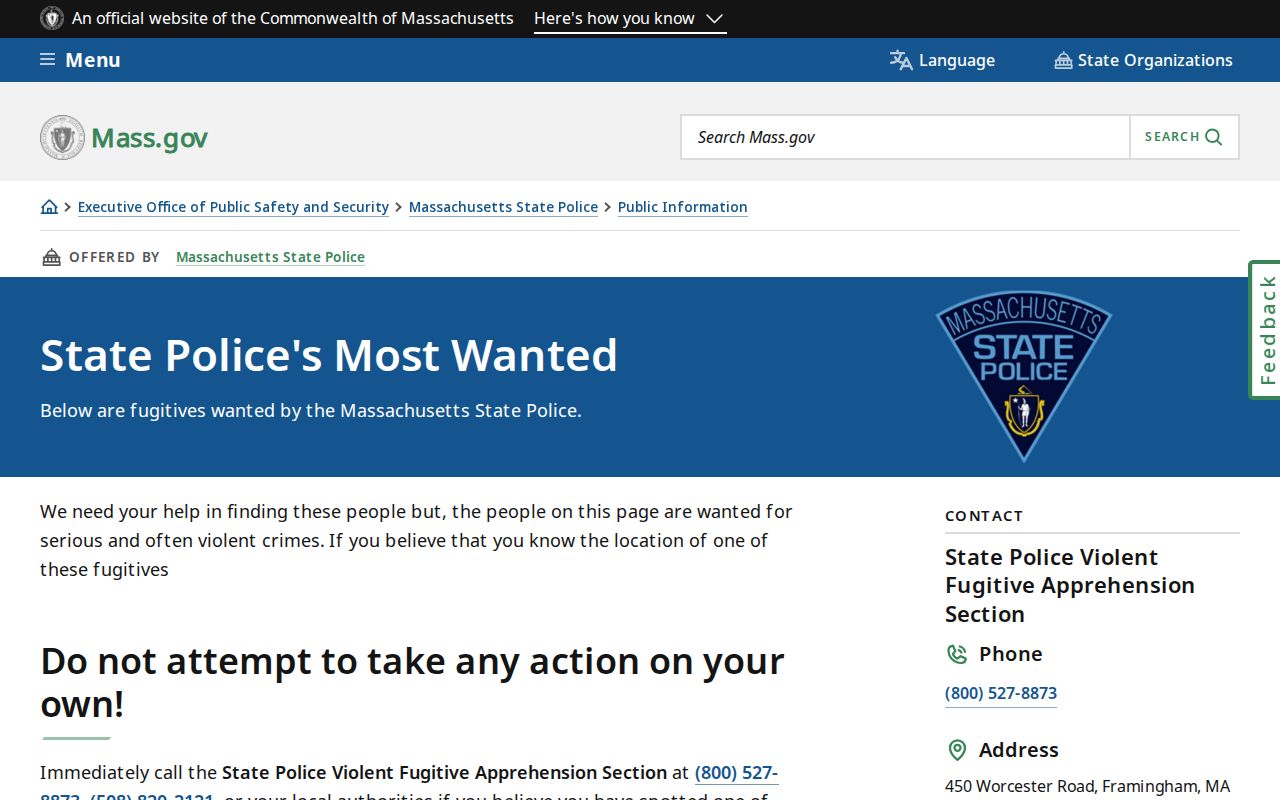
Statuses change. Confirm with the issuing agency's page before sharing an old notice or trusting a copied version.
Report a Massachusetts Wanted Tip
Use the contact route the publishing agency shows. These contacts play separate roles, since the State Police fugitive line is not a general warrant-status desk.
- Open the agency's official wanted page and confirm that the notice is still posted. Read its status label and directions before acting.
- Share only information you know with the contact listed for that case. Do not investigate, approach, follow, message, or confront the person.
- If there is an immediate threat or emergency, call 911. For a non-emergency tip, use the agency channel on the current notice.
Massachusetts State Police Violent Fugitive Apprehension Section
800-527-8873
508-820-2121
DOC Fugitive Apprehension Unit
508-473-9509
508-422-3481
Massachusetts State Police appears as an alternative contact.
U.S. Marshals Service
1-877-WANTED2
USMS Tips app
These routes differ. No statewide tip form exists. Each agency sets its own rules on anonymity and rewards. A notice may be old or point elsewhere, so when unsure use the agency page rather than a copied poster.
Massachusetts DOC and USMS Listings
The DOC list centers on people the department labels fugitives or escape-related. Older cases sit beside newer ones. Old entries and photos need a fresh check. Use "DOC fugitive" or "escapee" only when that is the department's own wording. It is not a DOC inmate-photo search. The Marshals run a different kind of page. Their District of Massachusetts site posts selected fugitive profiles with photos and descriptors. The agency's prisoner-photograph guidance says prisoner histories and photographs are not generally released as a routine public roster. A profile is therefore not a custody result. The Bureau of Prisons locator is separate too. It answers a custody question, not a warrant question. A notice does not mean custody. Read the agency and case label on the page before drawing any conclusion about where a person stands between systems.
Note: The DOC page contains older cases as well as newer material, which makes the official wording and current status important.
The DOC Most Wanted page labels the department's selected fugitive notices and contact information.
The page covers only fugitives the DOC itself spotlights, while a separate custody lookup service answers other questions.
Massachusetts Wanted Notice Details
The source page controls the notice. A repost does not. Check these details before tipping or describing someone publicly, since each agency lays out its page differently.
| Notice detail | How to read it |
|---|---|
| Issuing agency | Confirm whether the notice comes from State Police, DOC, or U.S. Marshals. Their lists have different missions. |
| Status wording | Repeat the label the agency uses. “Fugitive,” “escapee,” and other terms are not interchangeable descriptions of a conviction. |
| Date and current status | Check any displayed update or status information. A wanted page can remain online after circumstances change. |
| Photo or description | View images on the official notice. The USMS profiles may include photos and descriptors; the available research does not establish a fixed set of fields across all pages. |
| Tip route | Use the contact or app named on that agency's current page, not a number copied into a repost. |
A photo helps tell notices apart. It cannot confirm identity alone. If someone merely looks similar, hand the facts to the agency and let law enforcement judge them.
Check a Massachusetts Warrant Safely
A wanted list and a warrant index are not the same thing. The State Police page is a curated notice. No public statewide search returns every active Massachusetts warrant. A court docket can still help you find a case. Even so, the remote record makes no promise that every warrant status will surface there. MassCourts is the Trial Court's public-access portal. Its docket search instructions direct users to pick a court department and division, plus a location field where offered, before running a search. Party, event, docket, and disposition information may then appear. A name-only statewide search should not be assumed. What remote documents show varies by department and case type. The official public file sits with the clerk, register, or recorder where the case was filed.
- Start with the court named on any summons, notice, or known case paper. If you have no case number, use MassCourts' department and division fields, then narrow by location when the portal offers it.
- Compare the result using more than a name. Check the court, docket, event, and case details. A same-name result is not proof that it concerns the person you mean.
- Ask the clerk's office for the official case or warrant status when the online result is unclear or lacks the needed detail. The clerk can identify the public court record; protected or sealed material may not be available remotely.
- If the question concerns your own possible warrant, speak with a Massachusetts attorney or contact the court through counsel about the safe, lawful way to address it. Do not rely on a wanted-list match or an unofficial database.
If a listed person's identity or status is uncertain, leave them alone. Do not call, follow, or try to find them. Send a factual tip to the agency named on the official notice instead. For your own case, an attorney can contact the court. That attorney can work through a missed date or open matter properly. Do it without guessing from a public post.
Note: A same-name court result does not confirm identity; compare the court, docket, and case details before relying on it.
The court's official docket-search guide lays out the public route for locating case events. Those events may point you toward the issuing court.
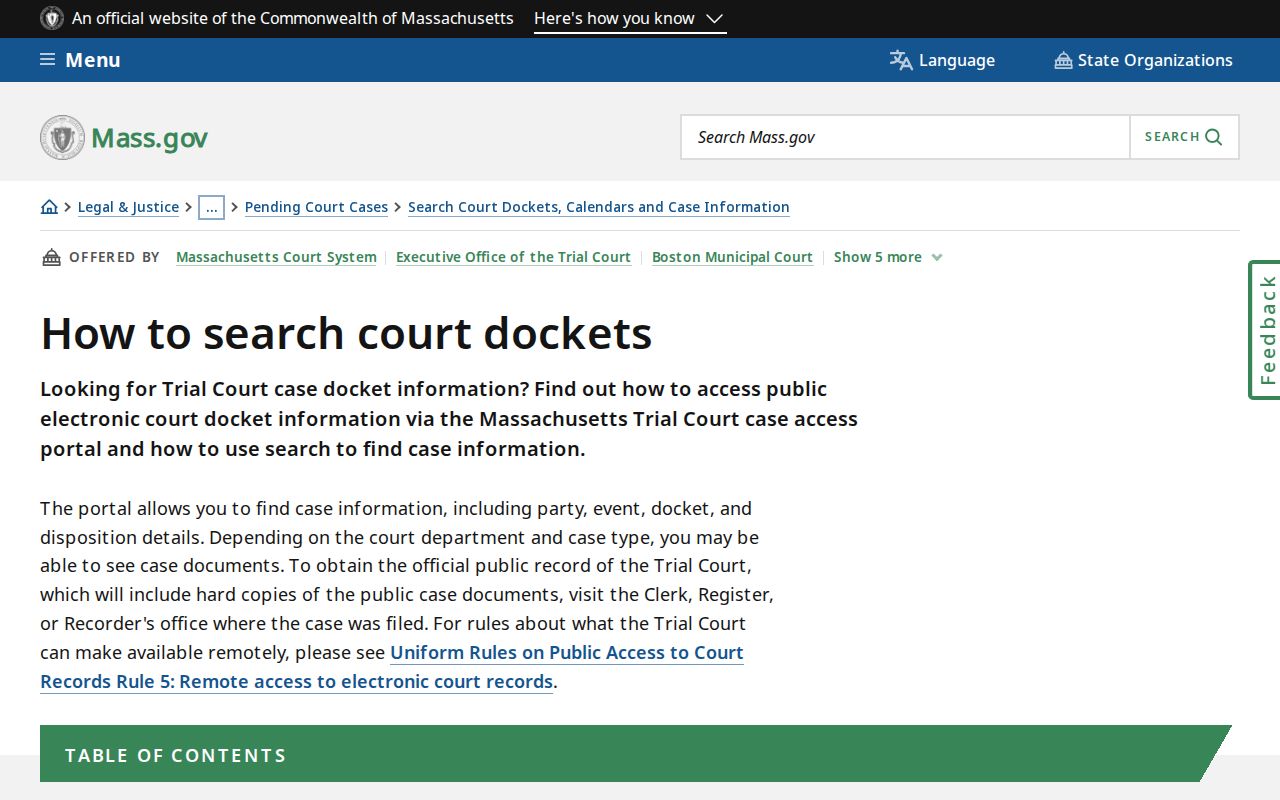
A docket helps you locate a case. But the clerk's official file governs a warrant's status. The VINELink landing page shows a separate custody-status service, one that answers a different question than whether a wanted notice or warrant remains active.
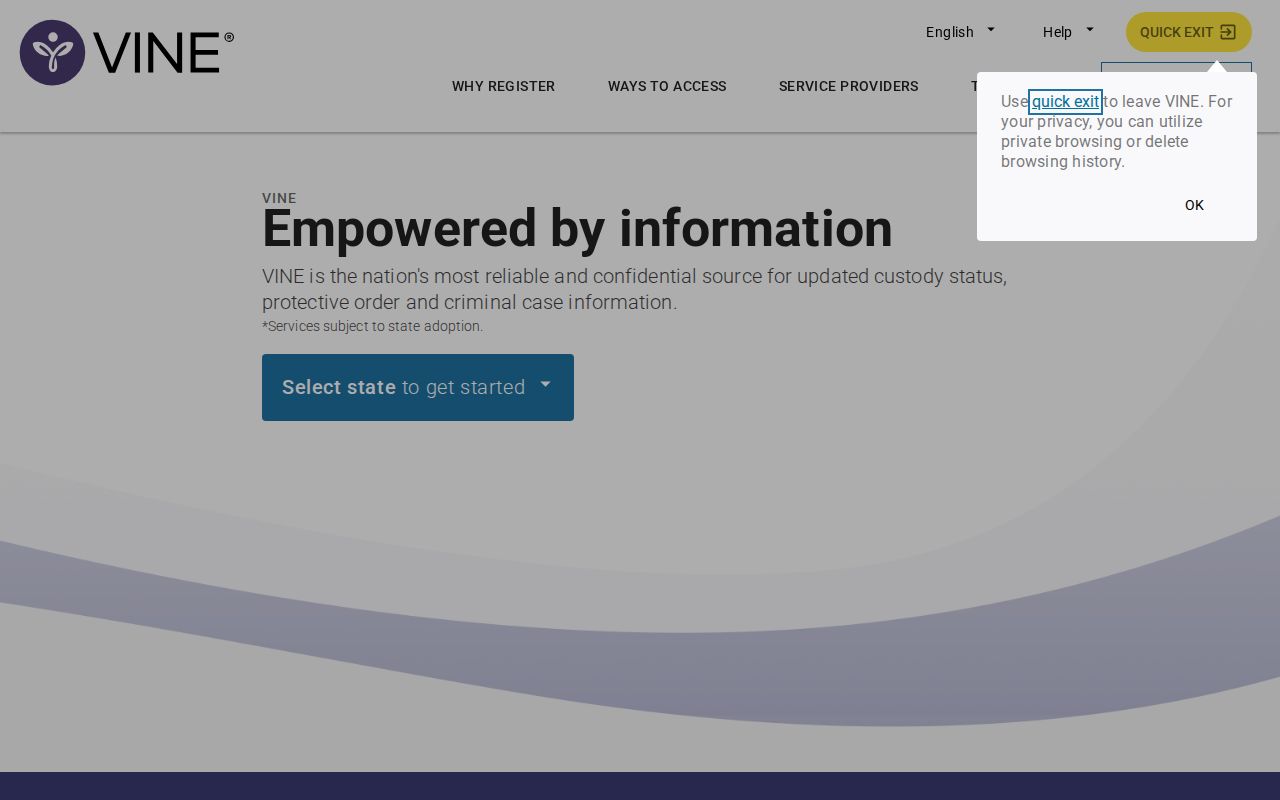
A custody result has limits. It cannot confirm that a warrant is active or that a person is wanted by law enforcement.
Warrant Types in Massachusetts
Massachusetts Rule of Criminal Procedure 6 governs court process in criminal cases. It separates a summons from an arrest warrant. The rule also explains how a warrant can follow a missed appearance. Those categories do not create a public statewide list. A short table here could never inventory every kind of court process.
| Process | What the Massachusetts rule says | What a searcher should confirm |
|---|---|---|
| Summons | For a defendant not under arrest or otherwise in custody, the rule generally uses a summons to give notice of proceedings and a return date, subject to its exceptions. | A summons is not an arrest warrant. Check the court, date, and instructions on the actual notice. |
| Arrest warrant | The District Court may authorize one in a criminal case, with an exception for an accused child under twelve; the Superior Court may authorize one after indictment. It must identify the person, state the substance of the charge, and direct arrest and return before court. | Confirm current status and the issuing court. A charge named in a warrant remains an charge. |
| Warrant after missed appearance | If a defendant does not answer a summons, the prosecutor may ask for a warrant or may have a new summons issued. | Ask the court handling the case how to address it. Do not treat a missing online result as proof that no warrant exists. |
Rule 6 directs a warrant to an officer. The officer must be authorized to serve criminal process. It may be executed anywhere in the Commonwealth. These points describe legal process, not tips for avoiding service. To resolve a possible warrant, go through the issuing court and legal counsel.
Note: MassCourts can help locate public case information, but the court that holds the file is the authority for its official record.
Massachusetts Wanted Lists and Court Records
A wanted notice serves a law-enforcement purpose; a court docket tracks proceedings. Neither stands in for the other. A docket may show that a case was filed, what events occurred, or whether a disposition was entered. The wanted page instead shows an agency's current request for public help. Timing differs too. New arrests and court updates may not appear together. When a record concerns an arrest or charge, check the official court record. Preserve the source's exact wording. To locate a recent Massachusetts booking or arrest record, use the statewide source path on the Massachusetts busted mugshots and arrest records page. It keeps jail and police records distinct from wanted notices. Court files and state-prison custody information stay separate too.